Warm Minimalist Interior Design: How to Get the Look Without the Cold
The warm neutrals, natural materials and few well-chosen pieces that make a warm minimalist home feel calm instead of cold.
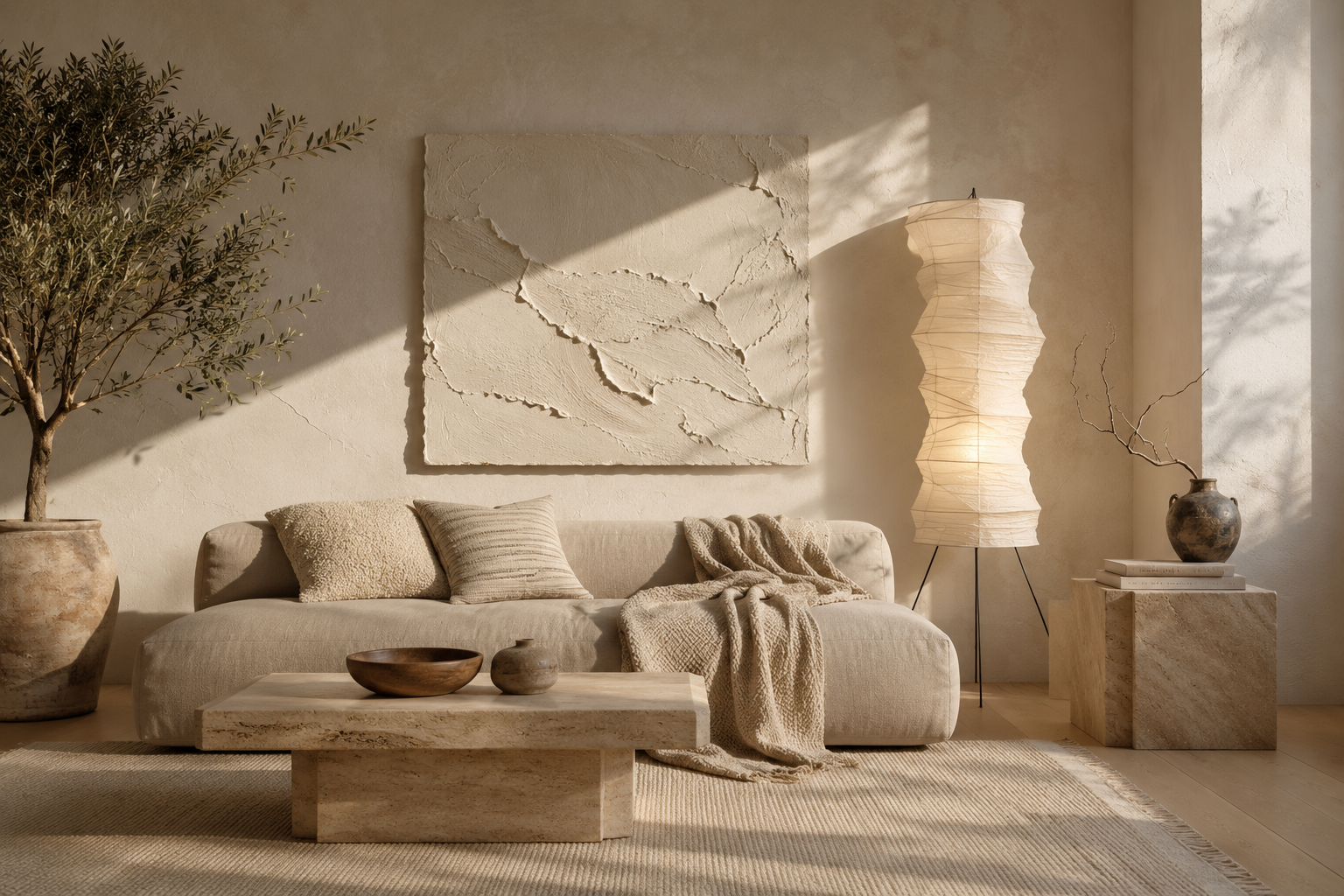
Minimalism has a reputation problem. Say the word and most people picture a white box: hard, echoey, a little unfriendly, the kind of room you admire in a photo but would never want to read a book in. Warm minimalism is the answer to that. It keeps everything good about minimalism, the calm, the order, the sense that nothing is fighting for your attention, and quietly swaps the cold for comfort.
If your idea of a beautiful room is one where you can breathe, but you still want to sink into it at the end of the day, this is your style. We call the person who lands here The Quiet Editor: someone who would always rather own five things they love than fifty things they tolerate.
Here's exactly how to get the look, from the palette down to the last cushion.
What is warm minimalism?
Warm minimalism is minimalism built on warm neutrals and natural materials instead of stark white and cold grey. Same discipline, different temperature.
Classic minimalism leans on bright white walls, glossy surfaces, black accents and a lot of empty space. It can look stunning and feel like a dentist's waiting room. Warm minimalism starts from a base of cream, oatmeal, sand and soft beige, then layers in timber, stone, linen and wool so the restraint reads as considered rather than sparse. The room is still pared back. It just feels like someone actually lives there.
The rule of thumb: keep the quantity of minimalism, raise the temperature of it. Fewer things, warmer things.
The warm minimalist colour palette
Everything hangs off the palette, and the palette is deliberately narrow. You want a tight range of warm neutrals that sit close together, so the whole room feels like one soft exhale rather than a set of competing choices.
A palette to work from:
- Warm white (around #F3EEE7) for walls and the overall envelope. Not a blue-white. Look for whites with a hint of cream or a warm undertone.
- Oatmeal and soft ecru (around #D9CDBC) for upholstery, linen and the mid-tones.
- Pale oak (around #C9AE86) for floors and timber pieces.
- Travertine and honed limestone (around #CBBBA4) for stone surfaces and accents.
- A single soft-charcoal (around #3C3A36) used sparingly, in an artwork or a lamp base, so the room has one quiet anchor.
Notice there's no bold accent colour. In warm minimalism the "colour" comes from material and texture, not from a feature wall. If you're itching to add a pop of teal, this probably isn't your style, and that's fine.
Materials and textures do the heavy lifting
Because the palette is so restrained, texture is what stops the room falling flat. This is the part people miss. Get the materials right and a five-item room feels rich; get them wrong and the same room feels bare.
The warm minimalist material kit:
- Pale oak, floors, shelving, a low table. Matte and natural, never orange or high-gloss.
- Warm-white limewash or plaster on the walls, for that soft, cloudy, hand-finished depth a flat paint can't give you.
- Oatmeal linen, slightly rumpled, relaxed, the opposite of crisp.
- Bouclé, one nubby cushion or chair to add a bit of tactile softness.
- Honed limestone and travertine, matte stone with visible veining and natural pitting, for a benchtop, a plinth or a basin.
- Matte ceramic, hand-thrown vessels in soft ecru, the kind of thing you want to pick up and hold.
The trick is to layer several tonal textures rather than several colours. A cream boucle cushion on an oatmeal linen sofa against a warm-white plaster wall reads as beautifully layered even though it's essentially one colour three ways.
The key pieces, room by room
You don't need much. You do need the right much.
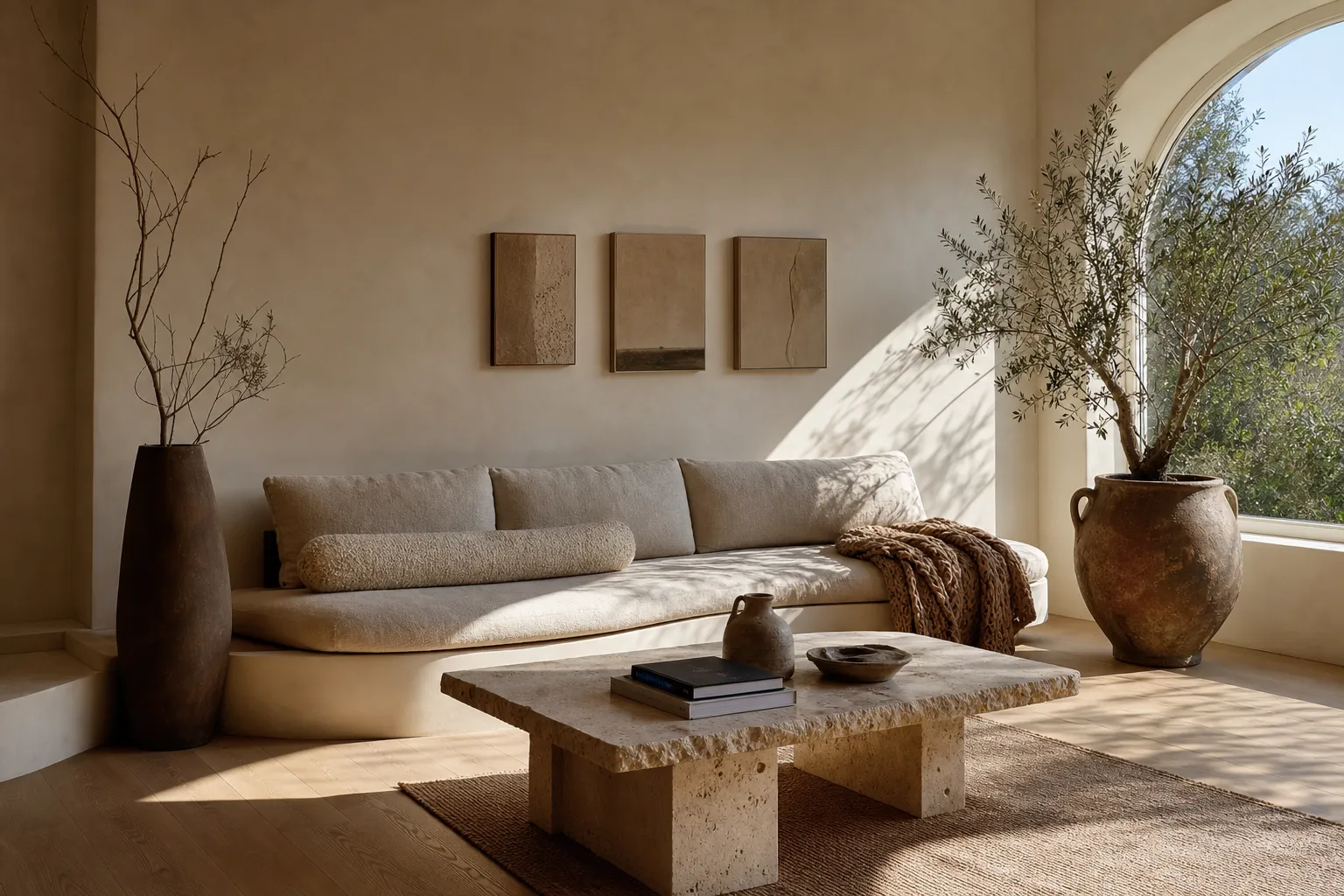
Living room. A low, deep linen sofa is the anchor. Add a sculptural paper floor lamp for soft ambient light, a chunky travertine or stone coffee table, one oversized textural artwork in ecru, and a single mature plant like an olive tree in a clay pot. Leave the walls mostly bare. The empty space is the point.
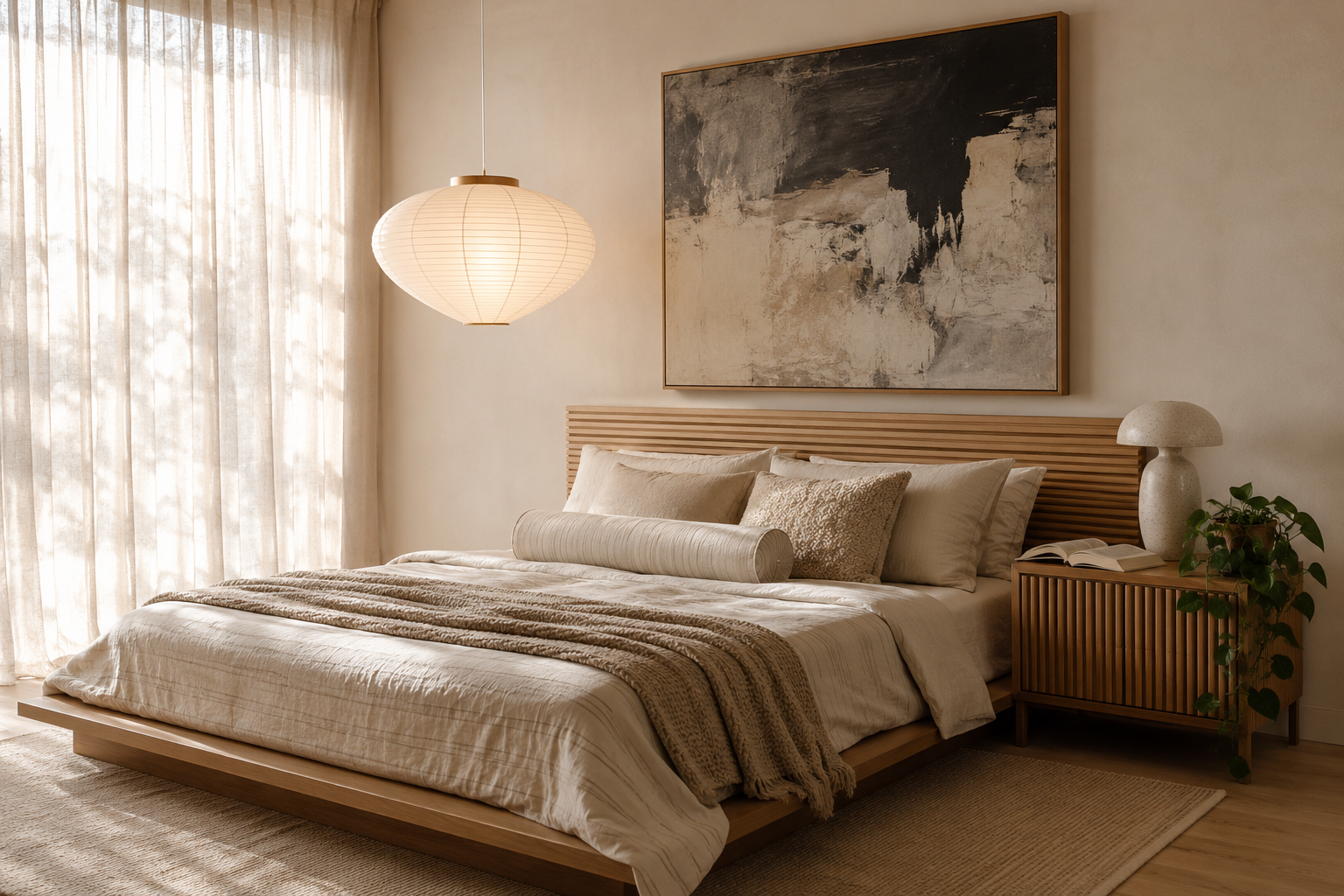
Bedroom. A low oak-slat bed dressed in layered stonewashed linen, a waffle-weave throw, one moody charcoal-and-ecru abstract above the headboard, and a fluted timber nightstand with a single speckled ceramic lamp. Floor-to-ceiling linen sheers instead of heavy curtains, so the light stays soft.
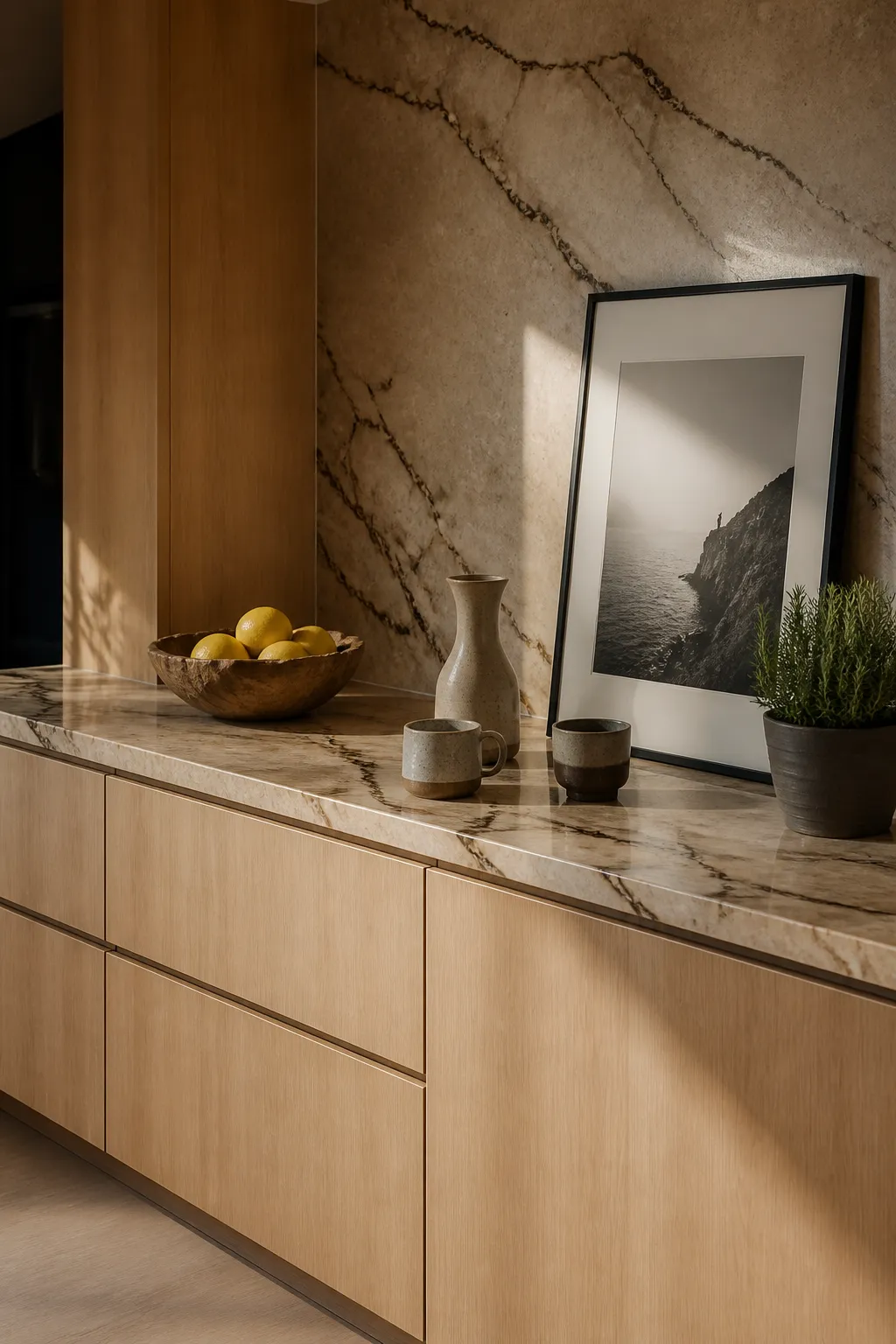
Kitchen. Handleless pale oak cabinetry with a book-matched travertine benchtop and splashback. Let the stone's veining be the only pattern in the room. A wooden bowl of lemons and a hand-thrown carafe are all the styling it needs.
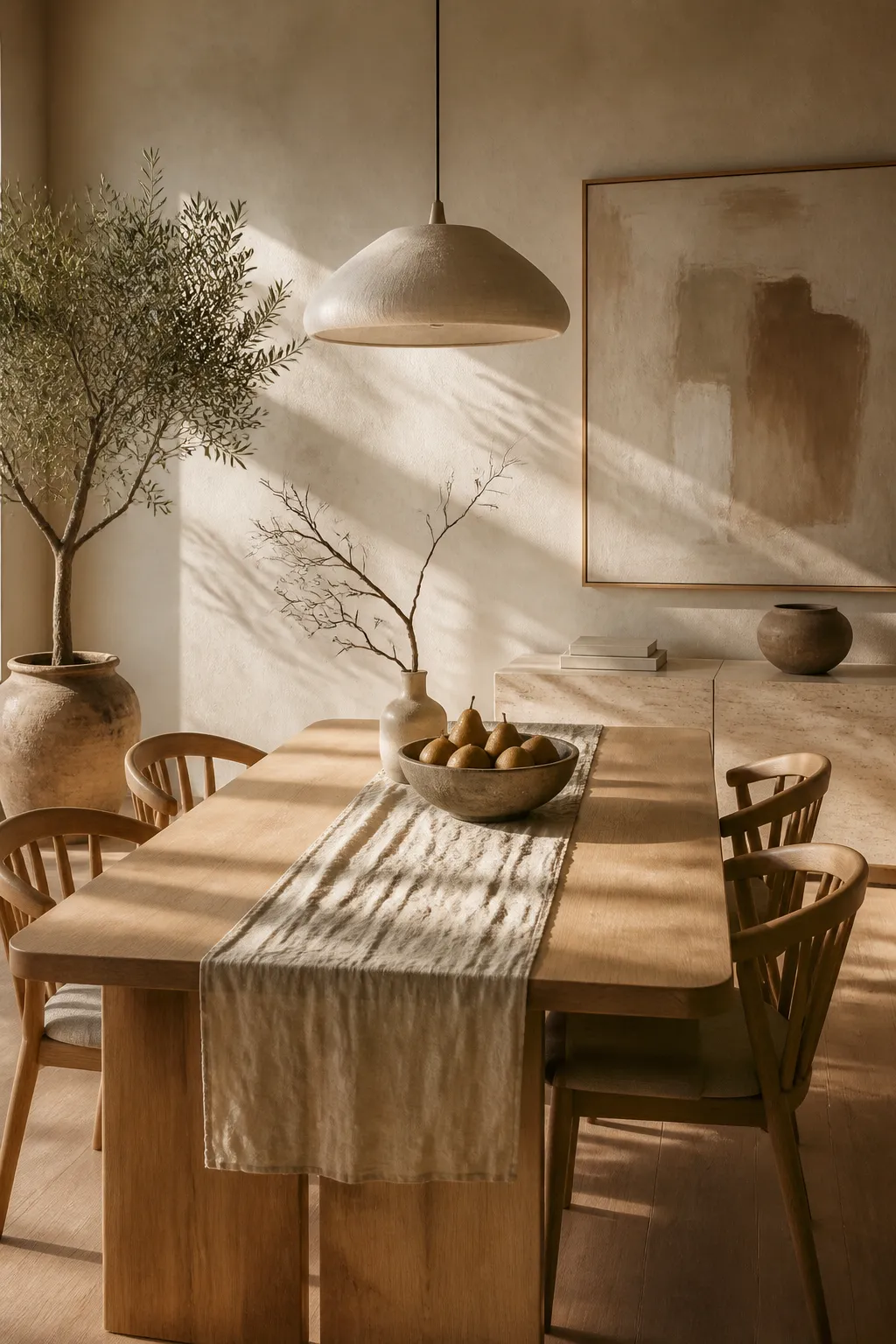
Dining. A solid pale oak table with softened edges, curved oak-slat chairs, a low linen pendant, and a single sculptural branch in a ceramic vessel as the centrepiece. One tonal abstract on the wall. That's the whole room.
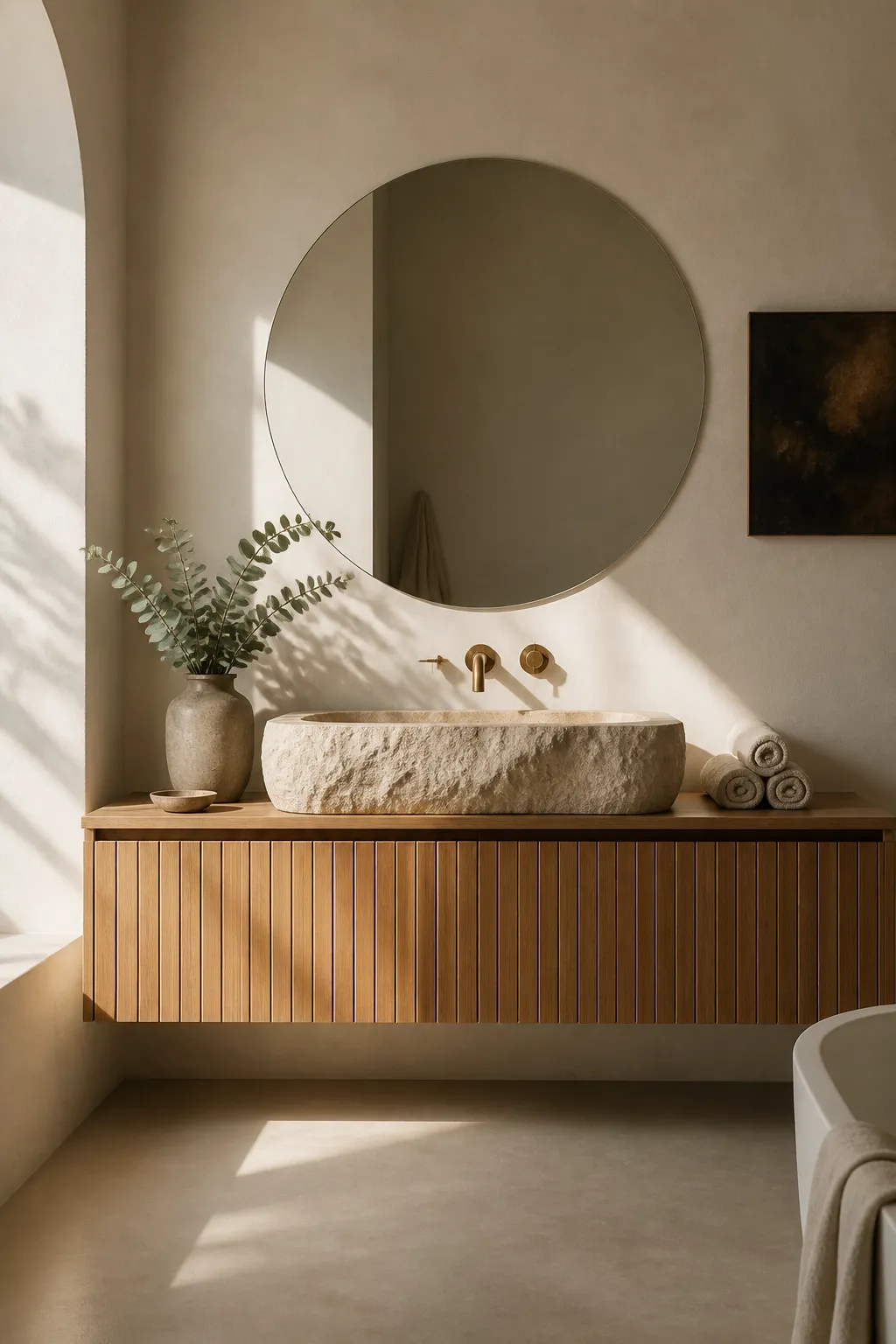
Bathroom. Warm-white microcement, a floating fluted-oak vanity, a chunky stone trough basin and aged-brass tapware. Spa-like, but warm rather than clinical.
Common warm minimalist mistakes (and easy fixes)
Going too cold. If you reach for a bright white and a cool grey, you've built a regular minimalist box. Fix: warm every neutral by one notch. Cream over white, greige over grey.
Forgetting texture. A flat, matte, single-colour room with no tactile contrast looks unfinished, not minimal. Fix: add at least three textures, a boucle, a linen and a stone, before you decide the room is done.
Over-editing. Minimalism isn't emptiness. A room with nothing personal in it feels like a display suite. Fix: keep one or two things that are clearly yours, a stack of real books, a plant you actually water, a piece of art you love.
Matching everything perfectly. Too matchy tips into showroom. Fix: let the timbers and stones vary slightly in tone. A little imperfection is what makes it feel collected rather than bought in one trip.
How to try warm minimalism in your own space
The hardest part of any style is picturing it in your room before you spend a cent. That's exactly what StudioReno is for. You can build a warm minimalist room with real products, see how the oak, linen and travertine actually sit together, and swap pieces until it feels right, no 3D software, no guesswork.
Not sure warm minimalism is your match? Take the two-minute style quiz and find out which of the 20 interior styles is actually you, then see it as a room you can build.
Try a warm minimalist room in StudioReno, free →
Warm minimalism FAQ
What's the difference between minimalism and warm minimalism? Classic minimalism uses cool whites, greys and hard surfaces, with a strong emphasis on empty space. Warm minimalism keeps the same pared-back discipline but builds it on warm neutrals and natural materials like oak, linen and stone, so the room feels calm and cosy rather than cold.
What colours work in a warm minimalist home? A tight range of warm neutrals: cream and warm white, oatmeal, sand, pale oak and travertine tones, with one soft charcoal used sparingly as an anchor. The interest comes from texture, not from bold accent colours.
Is warm minimalism expensive to achieve? Not necessarily. Because it relies on a few well-chosen pieces and plenty of negative space, you buy less overall. The spend goes into materials that feel good, natural timber, real linen, stone or stone-look surfaces, rather than into filling every corner.
Does warm minimalism work in small spaces? Very well. The restraint and light palette make small rooms feel larger and calmer. The key is resisting the urge to over-fill; let a small space stay open and let a few textural pieces carry it.